
Understanding New Bank Charter Activity

At Klarify, a new data services offering from Klaros, we apply data-driven analysis to illuminate and understand key developments in banking and fintech. For example, as we know from recent headlines, a large wave of applications for bank charters is a major trend. Even more interesting than the wave of applications is the array of important insights that can be gleaned from their details. Who’s applying? For what kinds of charters? What are they trying to achieve by forming a new bank? How do these applications compare to longer-term trends? How long will it take to get approval, and how do those timelines compare to history?
Answering these and other questions based on facts rather than intuition can be more difficult than it sounds. Source data for applicants filing for different types of bank charters are disclosed by a variety of federal and state agencies, often in differing formats, with differing taxonomies, and on conflicting or inconsistent schedules. Some critical facts are trapped inside PDFs rather than being available as structured data. Many charters require applications to multiple agencies; for instance, an insured national bank may require separate applications to the Office of the Comptroller of the Currency for the charter, the FDIC for deposit insurance, and the Fed for bank holding company approvals. Data on bank charters that don’t involve FDIC deposit insurance (such as national trust banks, state special purpose depositories, etc.) can be even more difficult to capture and process. Getting the data is just the first step. The differing formats and definitions must be reconciled. Critical information buried in PDFs must be pulled out and integrated. The data may be incomplete. There may be typos. And so on.
Deploying this complex and multifaceted process empowers us to develop a deeper, more nuanced, and data-driven understanding of critical developments in banking and fintech, including the current wave of charter applications. It turns out the surge in bank charter applications is far more nuanced than it first appears; there are several distinct waves of activity hiding within what appears to be a single engagement. Contact us for more insights and information, but we thought it would be useful to share a few observations from Klarify.
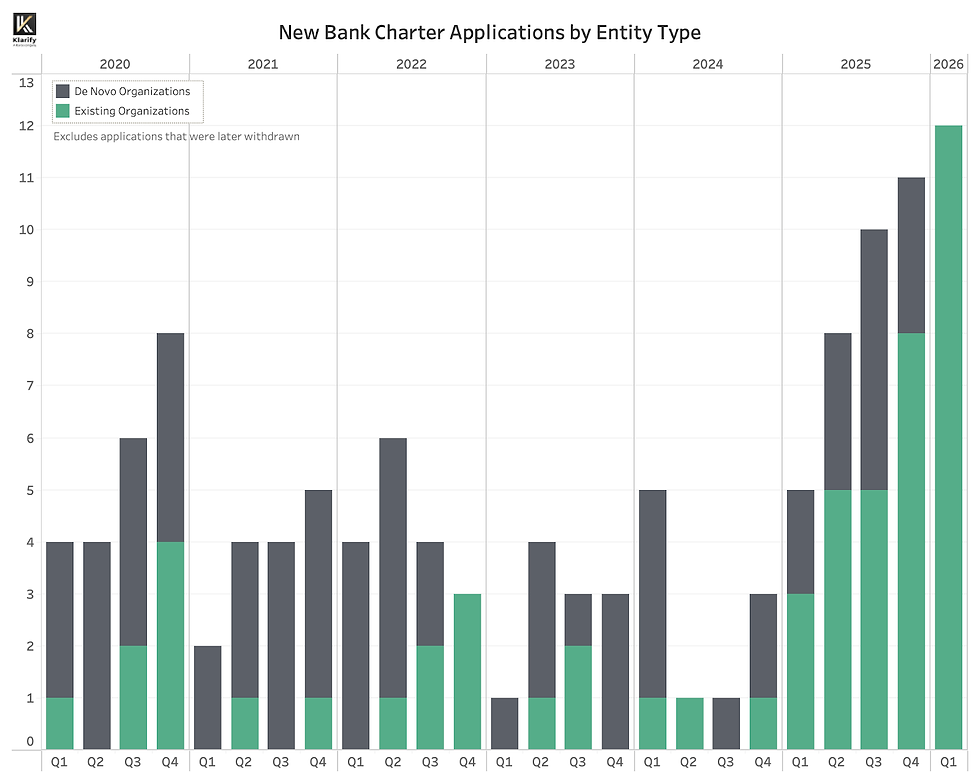
First, there is indeed a surge in charter applications, with 2025 applications far surpassing those of any other year over the last decade. Based on Q1 results to date, we expect applications in 2026 to post another record.

Second, regulators are indeed reviewing and approving applications for new charters far more quickly than was historically the case. Many believe (or hope) that the regulatory process will be more predictable and speedy, which is increasingly proven out in the data; even given the time lags inherent in regulatory processes, the data demonstrates that charter approvals are growing (15 so far just a couple of months into 2026!) while time to approval has fallen sharply from a median high of 321 days in 2024 to a median of 166 days so far in 2026. The OCC has publicly committed to meeting the statutory timeline of 120 days (long honored only in the breach); in that light, it is interesting to note that the last 13 approvals from the OCC had a median approval time of only 121 days. Preparing a bank charter application is a significant investment of time and money. It is perfectly logical that a material increase in the probability of approval and a decrease in the time required would drive the market to respond.

Third, the type of applicant for a new bank has shifted dramatically. Historically, the typical de novo bank application involved an experienced bank management team that raised capital to launch a new bank with a traditional business model from scratch. Applications since 2025 now also include a significant number of applications from established businesses seeking to add a bank to an existing business and legal structure. This trend has become even more pronounced in 2026, with all 12 bank charter applications submitted so far being from already established businesses.
Fourth, the surge in bank charter activity has also been disproportionately driven by national bank charter applicants relative to prior years. From 2021-2024, state chartered bank applications comprised 85% of all new bank charter applicants. In 2025, that number dropped to 47%, even though the number of state chartered applications actually increased relative to the prior four years. And in 2026, that shift towards the OCC is accelerating as national bank charters represent a whopping 92% of all new bank charter applications so far this year.
The data very clearly points to a number of distinct themes that suggest very different rationales and business models are each contributing to the growth in national bank charter applications; future blog posts will share more insights on these and other emerging themes as they continue to develop.

These are just a sample of the many data-powered insights into charter activity made possible by Klarify. We are confident that the wave of bank charter activity currently underway will be a critically important and transformative development for the banking sector, fintechs, and the economy as a whole for years to come. Please check out www.klarify360.com and drop your contact information there if you’re curious to see a demo or just have a question about our new data services offering.

